
The $6,000 Strike-Off Quote: How to Close Your Company Without Being Held Hostage
Closing a dormant Singapore Pte Ltd shouldn't cost thousands. Here is the realistic cost, step-by-step timeline, and ACRA strike-off requirements.
Deciding to close a company is never easy. It often comes after months of careful consideration, changing market conditions, or simply reaching the natural end of a business lifecycle. However, many Singapore founders face additional and unnecessary stress when they ask their existing corporate secretary to strike off a dormant business, only to receive a quote ranging between S$3,000 and S$6,000. This guide aims to demystify the process, reveal the true costs, and empower founders to close their company efficiently and transparently.
🤔 Why Do Corporate Secretaries Quote S$3,000 to S$6,000?
The high quotes for a straightforward strike-off often stem from one or more of the following factors:
Bundled Services: Some providers automatically include services that may not be necessary for a clean strike-off, such as complex tax clearance reviews, extensive accounting work, or unnecessary legal consultations.
Retainer Fee Padding: As mentioned in the original article, some providers prolong the process past the annual renewal date to charge another full year of retainer fees .
Lack of Transparency: Many quotes do not break down the actual ACRA fees versus professional service fees, making it difficult for founders to understand what they are paying for.
One-Size-Fits-All Pricing: Providers may have a standard high price for all strike-off cases, regardless of the company's specific situation, to cover potential complexities in more straightforward cases.
📊 The Real Cost of Striking Off an SME
Unless your business has complex outstanding liabilities, is under investigation, or requires a formal court liquidation, striking off a clean, solvent private limited company with ACRA is a straightforward administrative process. The costs are significantly lower than many quotes suggest.
Breakdown of Standard Costs
Cost Component | Description | Amount |
|---|---|---|
ACRA Filing Fee | Official government fee for processing the strike-off application. | Free (As of 2026) |
Professional Service Fee | For managing the process, ensuring compliance, and liaising with ACRA. | S$500 – S$1,200 (Typical range) |
Tax Clearance (if applicable) | Obtaining tax clearance from IRAS (often included in service fee). | S$0 – S$300 (Depending on complexity) |
Total Estimated Cost | For a clean, dormant company with no outstanding issues. | S$500 – S$1,500 |
💡 Note: The ACRA filing fee for voluntary strike-off is currently free . The quoted range above primarily covers the professional service fee for handling the administrative process, ensuring all criteria are met, and managing the timeline.
✅ Step-by-Step Strike-Off Checklist and Process
To qualify for ACRA strike-off, your company must meet these core criteria, which are rigorously checked

Phase 1: Pre-Application Preparation (Crucial for Success)
Before even logging into BizFile+, ensure your company meets every single criterion. Missing one can lead to immediate rejection and wasted time .
Cessation of Operations: The company must have completely ceased all business operations.
No Outstanding Liabilities: This includes:
No debts owed to IRAS (Inland Revenue Authority of Singapore).
No outstanding employers' contributions to CPF (Central Provident Fund Board).
No debts to any other government agency (e.g., GST, CPF).
Crucially: The company must have no assets and no liabilities on its balance sheet as of the application date . Any remaining assets must be distributed or liabilities settled/waived before applying.
Clean Legal Standing:
Not involved in any current or pending court proceedings (in Singapore or overseas).
No outstanding charges registered in the company's charge register.
Not subject to any ongoing regulatory action or disciplinary proceedings by any government agency.
Director and Shareholder Consent: The majority (or all) directors must consent to the striking off. This is a formal requirement .
Housekeeping in Order:
Annual Returns: All outstanding Annual Returns must be filed. While ACRA states you can apply with outstanding ARs if all other criteria are met, it's highly advisable to file them first to ensure a clean record and smooth processing .
Bank Accounts: All corporate bank accounts must be closed.
Registered Address: Ensure the company's registered office address and email address are up-to-date to receive all official correspondence from ACRA .
Phase 2: The Application Process (via BizFile+)
Once prepared, the application is submitted online through ACRA's BizFile+ portal using SingPass or CorpPass .
Application Submission: A director, company secretary, or an authorized corporate service provider (like us) can submit the application. There is no government filing fee .
Director Endorsement: If a corporate service provider submits the application on the company's behalf, all directors (or a majority) must endorse the application within 14 days via their BizFile+ notification inbox. Failure to endorse within this timeframe will cause the application to lapse .
ACRA Review: ACRA will review the application. If it is in order, ACRA will approve it and send a striking off notice to the company's registered office and officers' residential addresses .
Phase 3: The Gazette Notification Timeline (Minimum 3-4 Months)
This is the mandatory legal timeline that ACRA must follow, and it's the primary reason the process takes several months.
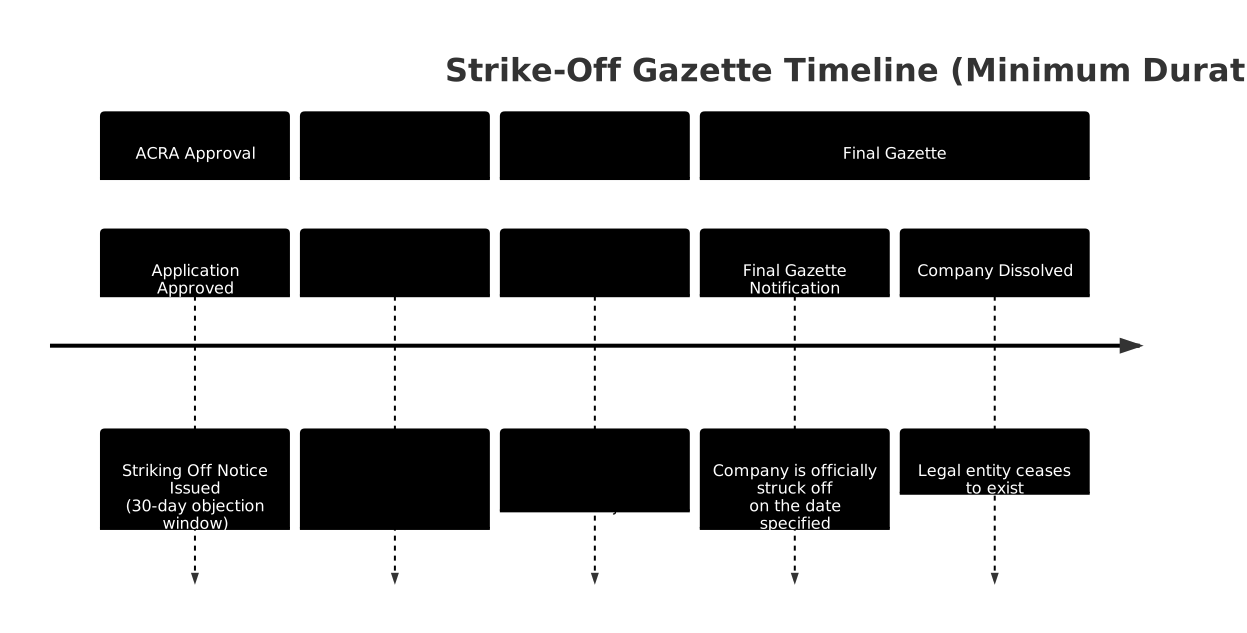
First Gazette Notification: If no objections are raised within the initial period, ACRA will publish the company's name in the Government Gazette. This marks the start of a statutory 60-day waiting period .
Objection Period: During these 60 days, any interested party (like a creditor or government agency) can formally object to the strike-off. If an objection is received, ACRA will notify the company, which then has two months to resolve the issue. If unresolved, the application lapses, and the process must be started again after the matter is cleared .
Final Gazette Notification: If no valid objection is raised or all objections are resolved, ACRA will issue a Final Gazette Notification. The company is officially struck off and dissolved on the date stated in this notice . This entire process from application to dissolution takes at least three months, often closer to four to six months .
⚠️ Beware the "Exit Tax" and Other Hidden Costs
The original article highlighted a critical and unethical practice: some providers deliberately delay the process. Here’s why and how to protect yourself:
The Annual Renewal Trap: Corporate secretarial services are often billed on an annual retainer basis. If a provider receives an instruction to strike off near the end of your current retainer period (e.g., in month 11), they might intentionally slow-roll the process. By ensuring the strike-off application is only submitted after the new retainer year has started, they can charge you for another full year of service fees for a company that is about to be closed.
Unnecessary Complexity: A corpsec provider might claim that your company needs extensive "tax clearance" work or that a simple strike-off is not possible due to "potential liabilities," justifying a higher fee. In reality, for a dormant company, obtaining a simple tax clearance from IRAS is often a straightforward process.
The Solution: Work with a provider who offers transparent, fixed-fee pricing for strike-offs. The fee should be clearly stated and should cover the entire process from eligibility check to final gazette, with no hidden charges. A reputable corporate secretary will manage the timeline efficiently to complete the strike-off within your current retainer period if possible, or pro-rate the fee fairly if it must extend into the next cycle.
🔄 What Happens After Strike-Off? (And What If I Need to Restore It?)
Once the Final Gazette is published, the company is dissolved and ceases to exist as a legal entity. It cannot own property, enter into contracts, sue or be sued .
Directors' Responsibilities: Directors are released from their statutory filing duties for that entity. However, they must ensure that the company's books and records are retained for the required period (usually 5 years) as per the Companies Act .
Restoration: A struck-off company can be restored to the register via a court order within six years from the date of striking off . This might be necessary if, for example, an asset was overlooked or a creditor comes forward. The restoration process itself is free to file via BizFile+ once the court order is obtained .
🧩 Alternatives to Strike-Off: When Is Winding Up the Better Option?
Strike-off is for clean, dormant companies. If your company has assets, liabilities, or is complex, a more formal process called Winding Up (or Liquidation) is required . This is not something a typical corporate secretary handles; it requires a licensed liquidator.
Feature | Striking Off (Section 344) | Members' Voluntary Winding Up |
|---|---|---|
Best For | Dormant companies with no assets/liabilities. | Solvent companies with assets to distribute. |
Cost | Low (S$500-S$1,500 professional fee). | High (liquidator fees, legal costs). |
Time | 4-6 months (administrative). | 6-12+ months (formal process). |
Key Requirement | Must have no assets and no liabilities. | Must be solvent and able to pay debts. |
Process | Administrative, via ACRA/BizFile+. | Formal legal process, supervised by liquidator. |
Outcome | Company dissolved. | Company dissolved, assets distributed. |
⚠️ Critical Warning: If your company has any unpaid debts, outstanding tax liabilities, or unresolved legal claims, do not attempt a strike-off. Making a false declaration on the application is a serious offense and can lead to investigation and prosecution . In such cases, you must seek professional advice on winding up.
🤝 How a Professional Corporate Secretarial Service Provider Can Help
A reliable and transparent service provider like Secroia will guide you through the entire process, ensuring it is done correctly the first time. Here’s what you should expect:
Free Initial Consultation & Eligibility Check: Secroia will first review your company's status to confirm if it meets all ACRA criteria for a straightforward strike-off, at no cost.
Clear, Fixed-Fee Quote: You should receive a detailed breakdown of costs, including the professional service fee and any disbursements (like IRAS fees). This should be a fixed fee, not an open-ended estimate.
Efficient Process Management: Secroia will handle all filings, endorsements, and communications with ACRA on your behalf, ensuring the process moves smoothly and within the standard timeframe.
IRAS Tax Clearance: We can be appointed by you (no additional fees required unless there are pending tax issues to be cleared) to obtaining the necessary tax clearance from IRAS, which is a mandatory prerequisite.
Transparent Timeline: Secroia will keep you informed at every stage, from application approval to First and Final Gazette notifications, and manage the process to avoid unnecessary delays or additional retainer fees.
❓ Frequently Asked Questions (FAQs)
Is the ACRA filing fee really free?
Yes, as of 2026, there is no government filing fee for submitting a voluntary strike-off application via BizFile+. The cost quoted by service providers is entirely for their professional services.
Can I strike off my company if it has outstanding Annual Returns?
Technically, yes. ACRA states you may apply if all striking off criteria are met, even with outstanding Annual Returns. However, it is highly recommended to file them first to maintain a clean record and prevent potential issues or delays during the review process.
What is the fastest way to close my company?
The fastest and most cost-effective way to close a solvent, dormant company with no assets or liabilities is via strike-off. The entire process, from application to dissolution, takes a minimum of three months due to the mandatory gazette notification periods.
What happens to my company's tax credits after it is struck off?
Any tax credits (e.g., unabsorbed capital allowances, losses) that the company is entitled to at the time of dissolution will be transferred to the Insolvency and Public Trustee's Office (IPTO). Shareholders can then approach IPTO to claim these credits, though a processing fee may apply.
✨ Conclusion: Taking Back Control of Your Business Closure
Closing your company should not be a second financial burden or a source of anxiety caused by opaque pricing and hidden fees. By understanding the straightforward ACRA process and the true costs involved, you can navigate the strike-off with confidence.
The key is to choose a corporate secretarial service provider who values transparency, offers fixed-fee pricing, and has a track record of efficient execution. They should be your partner in ensuring a clean and timely closure, not a source of additional stress. Remember, for a clean, dormant company, the entire process should be predictable and affordable, with professional service fees typically ranging between S$500 and S$1,200.
If you have received a quote that seems excessive, or if you are unsure whether your company qualifies for a straightforward strike-off, we encourage you to seek a second opinion with Secroia. A reputable provider will conduct an initial assessment at no charge and provide you with a clear, honest path forward.
Disclaimer: This article is provided for informational purposes only and does not constitute professional advice. The regulatory requirements and fees mentioned are based on information available as of July 2026 and are subject to change. Always consult with a qualified professional or the official ACRA website for the most current information.