
The Entrepreneur's Journey: Essentials of Starting a Business in Singapore
🧭 Introduction: Why Singapore?
As an entrepreneur who recently navigated the process of starting a business in Singapore, I can tell you firsthand that this city-state offers one of the world's most efficient and supportive ecosystems for business growth. Singapore consistently ranks among the easiest places to do business globally, with a straightforward incorporation process, competitive tax rates, and a robust legal framework that protects your intellectual property and assets.
Whether you're a local founder or a foreign entrepreneur looking to expand into Asia, understanding the essentials of starting a business in Singapore is crucial for long-term success. In this comprehensive guide, I'll share my insights and practical advice on everything from incorporation in Singapore to filing tax returns and contributing CPF to employees—the real-world challenges that every entrepreneur faces.
📊 Singapore Business Formation: A Quick Comparison
Before diving into the details, here's a comparison of the main business structures in Singapore:
Business Structure | Liability Protection | Tax Advantages | Compliance Complexity | Best For |
|---|---|---|---|---|
Private Limited (Pte Ltd) | ✅ Limited | ✅ Extensive exemptions | ⚠️ Moderate | Growth-focused businesses, startups seeking investment |
Sole Proprietorship | ❌ Unlimited | ❌ Minimal | ✅ Low | Very small businesses, solo entrepreneurs |
Limited Liability Partnership (LLP) | ✅ Limited (for partners) | ⚠️ Moderate | ⚠️ Moderate | Professional services (lawyers, consultants) |
Branch Office | ❌ Dependent on parent | ⚠️ Based on parent structure | ⚠️ Moderate | Foreign companies testing Singapore market |
🗺️ The Entrepreneur's Roadmap: From Idea to Operation
Starting a business in Singapore follows a structured pathway. Here's your visual guide to the entire process:

1️⃣ Pre-Incorporation Essentials: Laying the Right Foundation
Complete ACRA's Essentials of Starting a Business (ESB) Course (optional)
Before diving into paperwork, I highly recommend completing ACRA's free Essentials of Starting a Business (ESB) online course. This free invaluable resource covers business registration, taxes, and compliance requirements specific to Singapore. It takes just a few hours but provides crucial insights that will save you time and potential penalties down the road.
Choose Your Business Structure Wisely
For 95% of entrepreneurs, a Private Limited Company (Pte Ltd) is the optimal choice. It offers limited liability protection, meaning your personal assets are separate from your business liabilities. Additionally, Singapore offers substantial tax exemptions for new companies:
Full Tax Exemption on the first S$100,000 of normal chargeable income for the first three consecutive years
Partial Tax Exemption (75% on first S$10,000 and 50% on next S$190,000) thereafter 【turn0fetch2】
💡 Tip: Even if you're starting small, incorporate as a Pte Ltd from the beginning. Converting later involves additional costs and administrative hurdles.
Secure a Business Name and Registered Address
Your business name must be approved by ACRA before incorporation. Use ACRA's online name search tool to check availability. For your registered address, you have several options:
Residential Address: Possible under HDB's or URA's Home Office Scheme (requires prior approval)
Professional Registered Office Address: Find and rent your desired office location (CBD if you're in the financial sector or you prefer somewhere central or industrial park (B1/B2) if you can fulfil 60-40% warehousing/production vs ancillary office use requirements)
📖 Deep Dive: What is ACRA and Why Does It Matter?
The Accounting and Corporate Regulatory Authority (ACRA) is the national regulator of business entities and public accountants in Singapore. It maintains the BizFile portal where all business registration and filing occurs. Understanding ACRA's requirements is non-negotiable for business compliance in Singapore. They also offer the ACRA Academy with valuable free courses like the ESB.
2️⃣ Incorporation in Singapore: The Registration Process
The Core Requirements for Incorporation
To register a Private Limited Company in Singapore, you'll need:
Requirement | Description | Common Solution |
|---|---|---|
Directors | At least one ordinarily resident in Singapore (Singapore Citizen, Permanent Resident, or Employment Pass holder) | Nominee Director Service (for foreigners) |
Shareholders | Minimum 1, maximum 50 | Can be individuals or corporate entities |
Company Secretary | Must be appointed within 6 months of incorporation | Corporate service providers, such as Secroia, include this in packages |
Paid-up Capital | Minimum S$1 | Can be increased anytime after incorporation |
Registered Address | Must be a physical address in Singapore (P.O. Boxes not allowed) | Office rental or co-working space |
The Registration Timeline: From Start to Finish
The incorporation process can be remarkably efficient in Singapore:
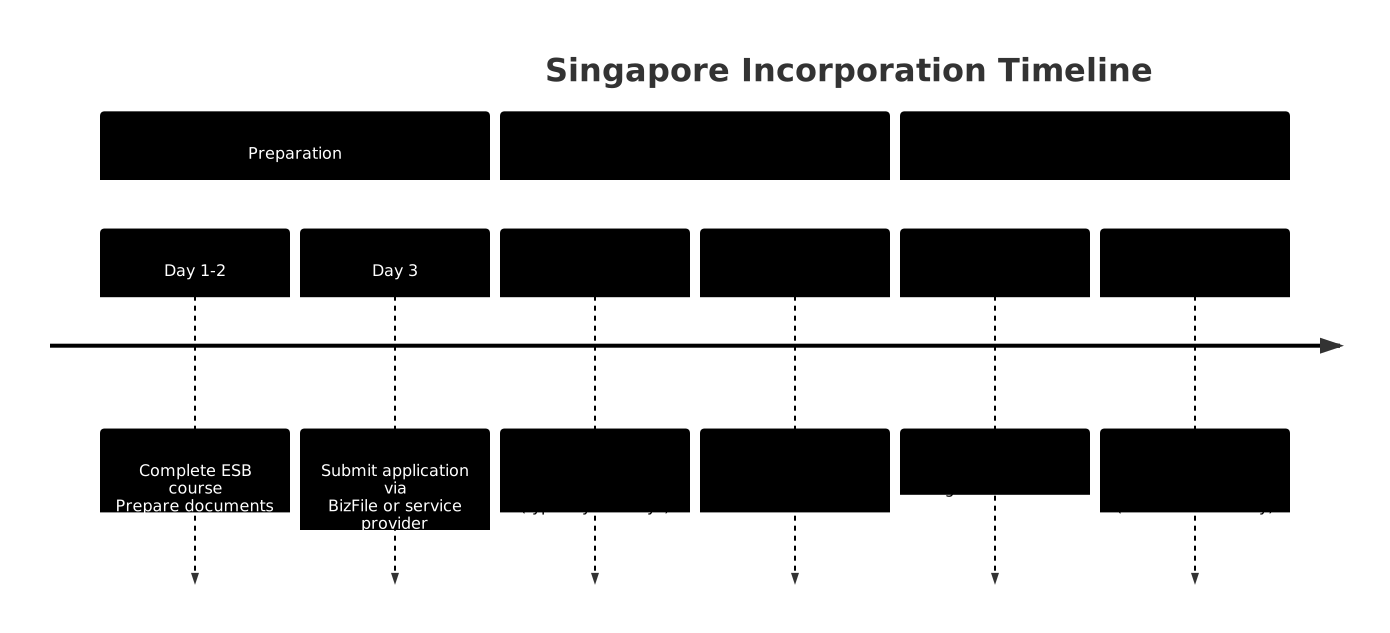
Pro Tip: Service providers like Secroia offer fully digital incorporation processes that can be completed in under 5 minutes once your documents are ready.
Special Considerations for Foreign Entrepreneurs
If you're not a Singapore resident, you'll face additional considerations:
Nominee Director: You must appoint a local ordinarily resident director. Many service providers offer nominee director services (costing S$1,500-2,400 annually) to fulfill this requirement.
Employment Pass (EP): If you intend to relocate to Singapore to run your business, you'll need to apply for an Employment Pass. The minimum qualifying salary is S$5,600 monthly (subjected to changes), and candidates must pass the COMPASS framework assessment.
Remote Incorporation: Fortunately, you don't need to be physically present in Singapore to incorporate your company. The entire process can be completed online with a corporate service provider like Secroia.
3️⃣ Post-Incorporation Compliance: Setting Up Your Business Systems
Appointing a Company Secretary (Non-Negotiable)
This is a statutory requirement under the Singapore Companies Act. Every company must appoint a qualified company secretary within 6 months of incorporation. The company secretary plays a crucial role in ensuring ongoing compliance with ACRA requirements, including:
Maintaining statutory registers and minute books
Filing annual returns with ACRA
Organizing Annual General Meetings (AGMs)
Advising on corporate governance matters
⚠️ Warning: Don't delay this appointment! ACRA takes non-compliance seriously, and penalties can accumulate quickly.
Opening a Corporate Bank Account
Your business needs a separate bank account to maintain the corporate veil and simplify accounting. Singapore banks have stringent "Know Your Customer" (KYC) requirements, so be prepared to provide:
Incorporation documents (Business Profile, Constitution)
Proof of registered address
Resolution of board of directors
Personal identification of directors and account signatories
Digital-first banks like Aspire business account (offered with their incorporation packages) can streamline this process, often opening accounts within days rather than weeks.
Registering for Taxes: What You Need to Know
Singapore has a territorial tax system, meaning you're only taxed on income sourced in Singapore. Here are the key tax registrations:
Tax Type | Registration Requirement | Key Rates |
|---|---|---|
Corporate Income Tax | Automatic upon incorporation | 17% on chargeable income |
Goods & Services Tax (GST) | Compulsory if taxable turnover > S$1 million | 9% (from 2024) |
Employee Withholding Tax | For payments to non-residents | Variable |
GST Registration Threshold: You must register for GST if your taxable supplies in Singapore exceed S$1 million in a 12-month period, or if you can reasonably expect to exceed this threshold in the next 12 months. Voluntary registration is possible if your turnover is below this threshold.
4️⃣ Ongoing Compliance: The Entrepreneur's Annual Checklist
Monthly/Quarterly Obligations
Payroll and CPF Contributions: If you have employees, you must make monthly CPF contributions. As of January 2026, CPF contribution rates for senior workers (aged 55-65) have increased, with employers contributing 34-35.5% for employees aged 55-60. Use CPF's online calculators to determine exact amounts.
GST Filing (if registered): Submit GST returns (F5 or F8) quarterly
Payroll Tax Filings: Auto-inclusion scheme for employment income data to IRAS by March 1st each year
Annual Compliance Requirements
This is where many entrepreneurs stumble, but missing these deadlines can result in penalties and strikes against your company's compliance record.
📋 Annual Compliance Checklist
Annual General Meeting (AGM): Must be held within 18 months of incorporation and subsequently every calendar year
Annual Return Filing: Due within 30 days of AGM (filed with ACRA via BizFile)
Corporate Tax Filing:
Estimated Chargeable Income (ECI): File within 3 months after financial year end
Corporate Tax Return (Form C-S/C): File by November 30th for calendar year companies
Financial Statements: Prepare and present audited/unaudited financial statements at AGM
Director's Report: Prepare annual director's report for AGM
Understanding Singapore's Tax Filing Requirements
Singapore's tax system is designed to be business-friendly, but you must understand your obligations:
Corporate Income Tax Filing Season 2026: All companies must file their YA 2026 Corporate Income Tax Return by November 30, 2026 at mytax.iras.gov.sg .
Tax Exemptions for New Companies:
Full Tax Exemption on first S$100,000 of normal chargeable income for first three years
Partial Tax Exemption (75% on first S$10,000 and 50% on next S$190,000) thereafter
Concessionary Tax Rates: Certain industries (like financial services and shipping) enjoy special tax rates.
5️⃣ Practical Tips from the Trenches
Cost-Saving Strategies for New Entrepreneurs
Bundle Services: Many corporate service providers like Secroia offer package discounts when you bundle incorporation with accounting and company secretarial services.
Start Small: You can begin with basic packages and upgrade as your business grows.
Utilize Free Resources: ACRA's free courses (ESB, FCSP) can save you thousands in professional fees by helping you understand compliance requirements upfront.
Common Pitfalls to Avoid
Delaying Company Secretary Appointment: This is a statutory requirement, not an optional extra. Non-compliance can result in ACRA penalties.
Ignoring Home Office Scheme Approvals: If using a residential address, ensure you obtain proper approval from HDB or URA before using it as your registered address.
Missing Tax Deadlines: Set up a compliance calendar with reminders for all filing deadlines. Consider using a service provider that offers automated deadline tracking.
Mixing Personal and Business Finances: This jeopardizes your limited liability protection and creates accounting nightmares.
6️⃣ When to Seek Professional Help
While DIY is possible, consider engaging professionals when:
You're a foreign entrepreneur without local knowledge or contacts
You lack time to navigate ACRA's requirements and IRAS filings
Your business structure is complex (multiple shareholders, foreign investments)
You need specific licenses (e.g., F&B, financial services, education)
Corporate service providers like Secroia offer comprehensive packages that typically include:
Company incorporation with ACRA registration
Company secretary services with our 24/7 whatsap first AI agent
Assistance with bank account opening
Tax registration and filing support
Ongoing compliance calendar and reminders with our digital vault
🎯 Conclusion: Your First Steps as a Singapore Entrepreneur
Starting a business in Singapore is a strategic decision that offers tremendous advantages, but it requires careful planning and ongoing compliance. Based on my experience, here's your actionable checklist:
Choose Your Business Structure - For most, a Private Limited Company is optimal.
Select a Corporate Service Provider - Compare packages from providers like Secroia to find the right balance of cost and service.
Set Up Your Compliance Calendar - Track all filing deadlines to avoid penalties.
Focus on Growth - With compliance handled, you can concentrate on what matters most—building your business.
Singapore's business ecosystem is designed to support entrepreneurship, but it rewards those who approach it with preparation and respect for regulatory requirements. By following this roadmap and leveraging the available resources, you'll be well on your way to building a successful business in one of the world's most dynamic economies.
💡 Final Tip: Join entrepreneur communities and networking groups in Singapore. Learning from others who have navigated this path can provide invaluable insights and support as you grow your business.
Ready to take the first step? Complete ACRA's free Essentials of Starting a Business course today and explore incorporation packages from trusted service providers to kickstart your entrepreneurial journey in Singapore.